Twee Abstraction

Twee Abstraction
curated by Alex Paik
January 6 - 29, 2012
Reception: Friday, January 6, 6 – 10pm
Exhibiting artists:
Lauren Collings
Suzanne Goldenberg
Siobhan Liddell
Andrew Masullo
Jeffrey Scott Matthews
Brooke Moyse
Alex Paik
Caroline Santa
Tamara Zahaykevich
[MORE IMAGES] [ESSAY BY ALEX PAIK]
PHILADELPHIA - Tiger Strikes Asteroid is pleased to announce the opening of its January exhibition, Twee Abstraction, curated by Tiger Strikes Asteroid member Alex Paik.
Twee Abstraction brings together the work of several abstract artists whose practices recall the sweetness and childish clunkiness of early twee pop music. Bands such as Talulah Gosh, The Field Mice, or Beat Happening abandoned the nihilistic and political overtones of punk music and combined its DIY spirit and straightforward, three-chord simplicity with a love of 60s jangly guitars and girl-group harmonies into a music that was decidedly lo-fi, straightforward, and delicate.
Similarly, the artists in Twee Abstraction exhibit a predisposition toward the straightforward, the fragile, and the hand-made. Whether it be through the use of fragile materials, through willfully amateur technique, or through a love of simple compositional strategies and bright color harmonies, these artists invite viewers to an experience that is intimate, playful, and gracefully underworked.
Exhibiting artists:
Lauren Collings
Suzanne Goldenberg
Siobhan Liddell
Andrew Masullo
Jeffrey Scott Matthews
Brooke Moyse
Alex Paik
Caroline Santa
Tamara Zahaykevich
Twee Abstraction in the Philadelphia Inquirer

“Twee Abstraction, at Tiger Strikes Asteroid, and curated by TSA member Alex Paik, is composed of nine artists from the younger generation who make every effort to undermine formality. The appearance of a lack of technique is celebrated in these paintings, which often employ fragile found materials and underworked surfaces. A look of abjectness is cultivated.
Three of this show’s works hone its ideals particularly well: Jeffrey Scott Mathews’ sewn canvas composition of red and white triangles, DLTA SQNC (RED HEX) (2011); Suzanne Goldberg’s delicate sculpture of wire, plastic netting and wood, The Lovable Pauper (2011); and Tamara Zahaykevich’s Pumpkin Queen (2011), a painted paper-and-foamboard construction that puffs out almost two feet from the wall, and charmingly so.”
[SAME/NOT, BY EDITH NEWHALL]
Twee Abstraction on the ArtBlog

“Down the hall from Grizzly in galleries next to each other reside some eye-popping works in bright, happy colors. Tiger’s themed show “Twee Abstraction” has a couple of pieces that, whether twee or not I am unable to say, but are pretty great works of color and shape. Tamara Zahaykevich’s “Pumpkin Queen,” a pastel easter-egg-cum-cupcake on the wall (made of foamboard, paper, acrylic, paint, glue) evokes birthday parties, pinatas, and bon bons of all sorts.
Alex Paik’s zig-zag color-pencil-striped paper construction “Prelude and Fugue” likewise brings up ideas of party games — rubiks’ cubes gone bananas, game boards to nowhere and something like what Frank Stella might have made if he ever had a sense of humor or the ability to not take himself soooo seriously.
Andrew Masullo’s “5326″ makes (in my mind anyway) a reference to the Canadian flag, only the hallowed maple leaf has been turned into a cheery, cherry-red splat.”
[AROUND THE WORLD AT 319 N 11TH, BY ROBERTA FALLON]
Twee Abstraction on [^]LAND

“A lot of abstraction shows miss the mark by being more about the individual works than about what abstraction can holistically contribute to one’s sense of experience. This is not the case here.”
[TWEE ABSTRACTION, BY ALEXANDER CONNER]
Twee Abstraction in the Philadelphia CityPaper
“There’s something about the descriptor “twee” that seems to welcome detractors. Haters will prattle on about how it’s just so sickly sweet and then knock its perceived lack of ambition. Granted, this debate is mostly a matter of taste, but if these cold-hearted hepcats want nothing to do with a return to playful innocence where jangly, lo-fi guitars and cooing vocals provide the soundtrack, then so be it. For everyone else, there’s “Twee Abstraction,” the latest group exhibition from Tiger Strikes Asteroid. Alex Paik curates and exhibits as he and eight others (including Andrew Masullo, who was just tapped to show at the 2012 Whitney Biennial) “take the mentality of early twee-pop and apply it.” Primarily using fragile materials such as found wood, wire, fabric and folded paper, the exhibition isn’t so much in-your-face as it is please-look-at-this, for it was made with care.”
[TWEE ABSTRACTION, BY CHRIS BROWN]
Tiger Strikes Biennial

Congratulations to Andrew Masullo and Joanna Malinowska, who were both picked for the 2012 Whitney Biennial! Andrew Masullo is currently in Twee Abstraction, and Joanna Malinowska was in Summer Above in June 2011.
Twee Abstraction
curated by Alex Paik
January 6 - 29, 2012
Twee Abstraction - Essay
It makes sense that a show called Twee Abstraction would take place in an artist-run exhibiton space, since its birth is rooted in the DIY, independent music scene of punk and post-punk. Abandoning the political overtones of punk, the early twee pop bands combined the DIY attitude and straightforward, three-chord rock of punk with childish lyrics and bright 60s girl group harmonies. Their music was called a “revolt into childhood” by some commentators, but branding these bands as a faux naive movement doesn’t do them justice. While there were often childish elements to twee pop, it is really the way that these musicians combined a serious playfulness with a punky, DIY approach to their instruments and song structure that is the focus of this exhibition.
The artists in Twee Abstraction can be seen as descendants of the Post-Minimalism giant Richard Tuttle, who responded to Minimalism in a way not unlike how the twee bands responded to punk rock – by replacing the endgame philosophy of Minimalism with a radical playfulness and restless search for serendipity from humble materials. Thirty years on, this radical playfulness permeates the processes and materials of many contemporary artists working today . Raphael Rubinstein called this “Provisional Painting” in an eponymously titled Art in America article, while, more recently, Sharon Butler explored this idea in a Brooklyn Rail article entitled “The New Casualists.”
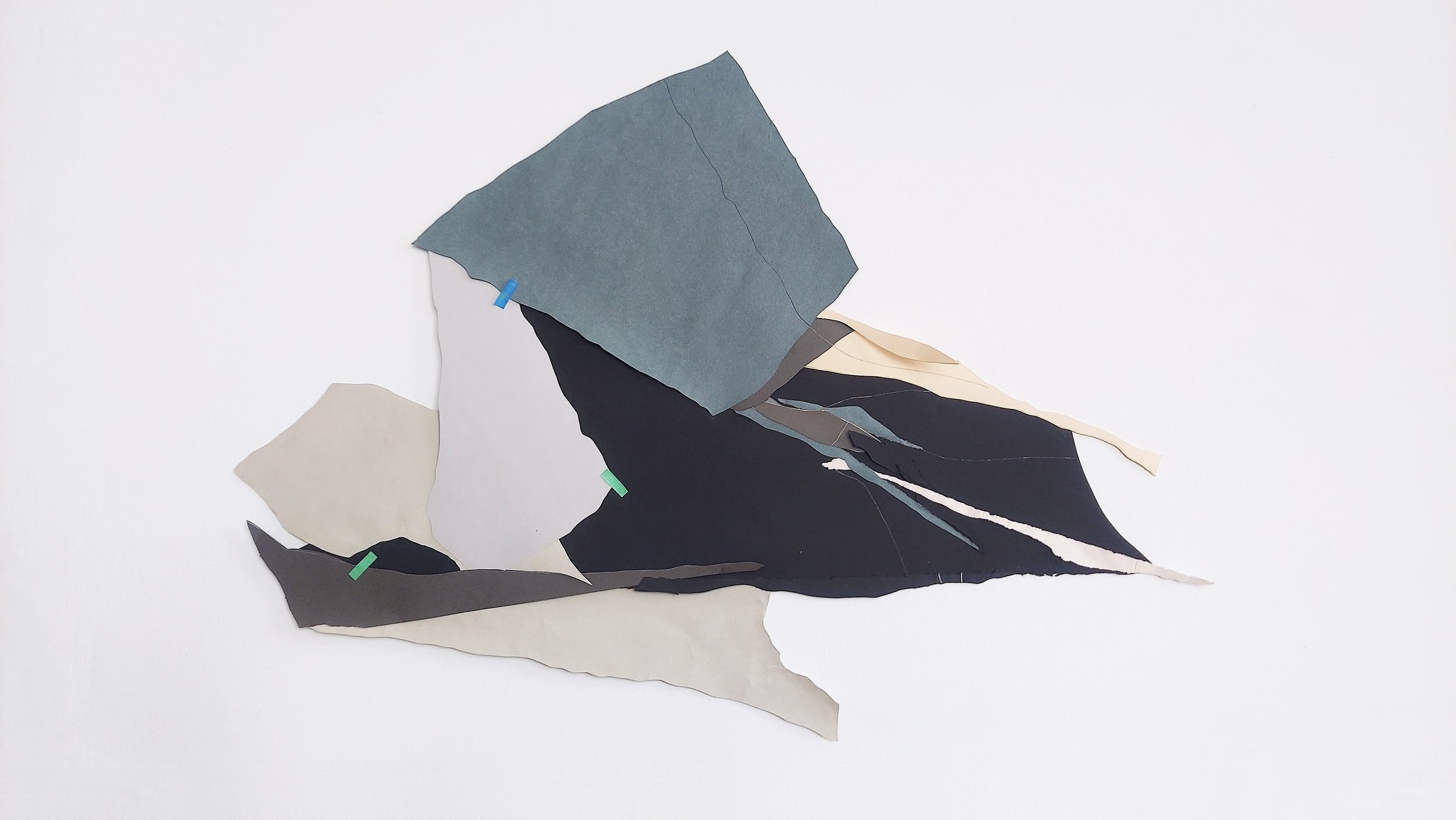
One can feel this “revolt into childhood,” in the work of the artists in Twee Abstraction. Lauren Collings’s Capton Bunc is literally finger painted and crudely collaged, recalling arts and crafts time in elementary school, while Tamara Zahaykevich’s Pumpkin Queen feels like an oversized toy with colors pulled from a Lisa Frank Trapper Keeper. Alex Paik’s Prelude and Fugue (Cootie) feels like a child’s clunky origami interpretation of an early Frank Stella and is, in fact, named after a “cootie catcher.”
The more “straightforward” artists in the show mirror the simple, three chord rock that the twee pop bands inherited from punk. Andrew Masullo’s 5236 reveals an elegance in its seemingly straightforward composition, while the loose brushiness of Brooke Moyse’s Small Yellow Diamonds with Pink Lines creates a complex painterly space through deceptively simple means.
The artists in Twee Abstraction emphasize the slight imperfections of non-mechanical mark making, much like how the slightly out of tune guitars or the hissing white noise from lo- fi recording methods permeate the music of early twee pop bands. Siobhan Liddell’s Untitled combines casually crumpled up paper with decidedly hand-cut forms, while Jeffrey Scott Matthews’s strange rug-quilt’s beautifully sewn triangles are stained with grit and paint splatters.
This “casualist” approach to materials and markmaking mirrors twee pop’s DIY aesthetic. Whether it is through Suzanne Goldenberg’s gracefully underproduced The Lovable Pauper, which feels almost accidental in its construction, or through Caroline Santa’s radically under-composed bulletin board that blurs the line between found and constructed object, the artists in Twee Abstraction exhibit an extreme trust in their materials and a distaste for overproduction.
Country musician Harlan Howard once said that all you needed to write a good country song was “three chords and the truth.” In many ways, the artists of Twee Abstraction follow this maxim – by taking a lo-fi and straightforward approach to artmaking, these artists manage to reveal some truth about their materials or about the process of artmaking through work that is refreshingly sincere, graceful, and playful.
— Alex Paik is an artist and was the founder and director of Tiger Strikes Asteroid. He currently lives and works in New York City.
Ethan Greenbaum picked as one of Modern Painters’s “100 Artists to Watch in 2012”

Congratulations to Ethan Greenbaum, who was recently picked as one of Modern Painters’s “100 Artists to Watch in 2012.” Ethan’s work was in No Objective in August 2009.
Gerard Brown: ” “

Gerard Brown: “ ”
November 4 - December 18, 2011
Reception: Friday, November 4, 6 – 10pm
[MORE IMAGES]
PHILADELPHIA – Tiger Strikes Asteroid, Philadelphia’s artist-curated exhibition space presents “ ”, an exhibition of new works on paper by Philadelphia artist Gerard Brown. The show opens with a reception on First Friday, November 4, 2011. The gallery is located at 319 N. 11th Street, Philadelphia, PA.
The exhibit of paintings and prints continues Brown’s exploration of the intersections between reading and seeing, and its punctuated title (which can be read as “blank quote” or “smart quotes”) alludes to the use of others words in the work. Two large pieces dominate the show; a multi-panel drawing in gouache on paper translates Frank O’Hara’s 1957 poem “To the Harbormaster” into nautical code flags, and a 32-part digital print conflates images of oceanographic satellite photography with James McBride’s bestselling 1996 memoir, “The Color of Water”. “I want to know what happens when things are misunderstood,” Brown says, “when messages that are encoded are not seen as meaningful, or when an attempt to communicate directly is seen as a formal gesture.” During the run of the exhibit, the gallery will release an essay by artist David Stephens and art writer Robin Rice that discusses the works.
Gerard Brown is an Assistant Professor and Chair of the Foundation Department at Temple University’s Tyler School of Art. A longtime participant in the Philadelphia art community, he contributed art reviews to the Philadelphia Weekly and Seven Arts magazine in the 1990s and, with City Paper critic Robin Rice, began eyelevel, a newsletter of art criticism that appeared occasionally throughout the late 1990s. He has organized exhibits and contributed essays to galleries and museums throughout the region, and is currently the Resident Scholar at the Center for Art in Wood, where he organized “Turning to Art In Wood: A Creative Journey” in observation of the newly re-named organization’s 25th anniversary. This is Brown’s third one-person exhibit, and his first in Philadelphia.
Gerard Brown: “ ”
November 4 - December 18, 2011
Alex Paik: Start to Move

Alex Paik: Start to Move
October 7 - 30, 2011
Reception: Friday, October 7, 6 – 10pm
[MORE IMAGES] [INTERVIEW WITH MATTHEW SEPIELLI]
PHILADELPHIA - Tiger Strikes Asteroid is pleased to announce the opening of its October exhibition, Start to Move, featuring new work by New York based artist Alex Paik.
“Start to Move” is a song from post-punk band Wire’s seminal album, Pink Flag. Trouser Press said of the album: “The group manipulated classic rock song structure by condensing them into brief, intense explosions of attitude and energy.” Similarly, Alex Paik’s new small-scale paper assemblages feel like dense clusters of brightly colored forms that threaten to simultaneously explode and collapse. The new work hugs the line between being tightly composed and loosely improvised and recall the early formal experiments of the 60s and 70s and the inventive abstraction of Paul Klee or, more recently, Thomas Nozkowski . There is a sweetness about the work in the twee color palette and the toy-sized scale, but at the same time a fuck-all swagger in the laughably lo-fi paint handling and angular, chopped up forms.
Alex Paik received his MFA from the University of Pennsylvania and his BFA from Penn State University. He was the founder and director of Tiger Strikes Asteroid and currently lives and works in New York. He has shown throughout the United States, including a recent solo exhibition at U-Turn Art Space in Cincinnati, OH and a group show called Get on the Block at Camel Art Space in Brooklyn, NY.
moving on

moving on
curated by Ryan McCartney
Timothy Belknap, William Blackhurst, Carolee Schneemann
September 2 - October 2, 2011
Reception: Friday, September 2, 6 – 10pm
[MORE IMAGES] [ESSAY BY RYAN MCCARTNEY]
PHILADELPHIA- Tiger Strikes Asteroid is pleased to announce the opening of its September exhibition, moving on, featuring the works of Timothy Belknap, William Blackhurst, and Carolee Schneemann.
moving on presents work from three artists; each dealing intimately with motion, the body, and the relationship between. Whether in object, image, or both, the works in the show treat movement as an integral component in content and in context, rather than as technique or novelty. Each artist subverts expectations of their media, through a variety of means including scale shift, humor, raw experimentation, and the invocation of cultural taboo, in order to ground the viewer in experience- to ground the viewer in the physical, the now of the relationship before them. Works on view will include experimental animation, kinetic sculpture, and Carolee
Schneemann?s 1965 film,“Fuses”.
Tim Belknap is a multimedia artist, living and working in Philadelphia. He has shown extensively, both locally and nationally. William Blackhurst is an animator and a painter, currently residing in London, UK. This is his first gallery exhibit. Carolee Schneemann is a world renowned, groundbreaking artist who has influenced generations of fellow artists.
Interview with Alex Paik
Matthew Sepielli: The title of the show is taken from a song on Wire’s Pink Flag album and music seems to play an important role in the work. Can you talk about this some more? Does it serve as a soundtrack while the work is being made? How does this filter into the pieces?
Alex Paik: I didn’t come to the visual arts seriously until college, so the first place that I learned how to think deeply about art was in various community orchestras that I played in when I was in high school. I was never a great violinist but I loved classical music. (I still do, of course). Classical music has a very specific type of abstraction inherent to it, and that way of thinking has significantly shaped the way I approach art.
I’m also interested in bringing an element of time to the pieces. Painting is interesting because everything is there at once but it also unfolds in time as you spend more time looking at the painting. I like that each of my pieces changes as you change your viewing angle, but you still retain what you saw before in your short-term memory, which also affects your experience of the piece.
I listen to music all day, every day, but it’s not really a literal soundtrack to the work. I’m more interested in exploring musical structures and bringing those into my work — right now I’m mostly interested in fugues, the polyphonic improvisation found in early jazz, and the way post-punk was able to recover a sense of the personal after punk became a Movement and a Brand.
MS: In many ways your work seems to be trying to recover a sense of the personal as you describe post-punk to be doing- do you see the abstraction as something that has been turned into a brand? Is the work you make partially an attempt to recover abstraction?
AP: Well, I wouldn’t say that I’m attempting to do something as grand as “recover abstraction,” but I am very attracted to work that is simultaneously super abstract/cerebral and intimate, even humble. My favorite works of art are the late Beethoven string quartets – they are so abstract, but they still manage to stay grounded on a human scale, if that makes any sense.
Abstraction can also tend to feel humorless. When a work of art (or a person, for that matter) is able to have a sense of humor about itself, there is a sense of freedom there that feels more inviting to the viewer.
If you set up a somewhat arbitrary branching off point between the abstractions of Klee and Kandinsky, you can see how my work is much more aligned with Klee’s working process (Klee was also a fairly accomplished violinist). His abstractions were more interested in invention and problem solving within the work — an inside-out approach. Kandinsky, on the other hand, approached his work from the outside-in with his theories on what specific colors and geometric forms symbolized. This is a very oversimplified way of looking at these two artists, of course, but I think it’s useful in illustrating where I see myself coming from in terms of art historical lineage.
MS: You note that the works at times are tightly composed and also improvised- do specific works take the form of being solely composed and others solely improvised or for you, are these two polarities integrated in each piece?
AP: I work on several pieces at once — at least five or so. I keep most of my scraps, so oftentimes the negative shape of one piece will become the starting point for another piece. I start painting by responding to something about the form itself — usually an edge or some other motif becomes the melodic fragment that the whole piece revolves around. After a certain point I’ll usually let the work sit on my studio wall for a while, then I’ll come back in and do something else that responds to something in the specific piece — I’ll cut a huge chunk off, fold it in on itself, add something else, or even combine two or more pieces into one.
My working process is essentially doing a lot of improvisational sessions, and then cutting, pasting, editing those sessions into some sort of coherent whole (much like how parts of Miles Davis’s Bitch’s Brew was composed). In terms of developing my pieces, they are composed much like a fugue – I typically start with one sort of motif/theme/melodic fragment and then have that same theme appear again and again in different voices and configurations (folded, upside down, fragmented, transposed, etc).
MS: The idea of economy comes up again and again for me in your work (even in their packing and shipping, i.e. a solo show that fits into a small box)- whether improvised or composed the works seem to have a quiet and playful confidence- that things are done to them and then left and not fussed over. With this in mind can you talk a bit more about what happens in a work from start to end and how the piece comes to be?
AP: I’ve always been attracted to work where the artist has enough confidence to leave something alone. When something feels overworked, it feels dead — strangled by the artist’s ego, I suppose. There’s also a gracefulness that comes from a restrained hand that I’m very attracted to.
MS: Earlier work of yours referenced specific elements of culture (such as Nintendo games) while these works seem decidedly non-objective. Is this a fair statement or do you feel like these are still rooted in such cultural elements? What brought about this change?
AP: For a long time I’ve been interested in deflating the anthemic, macho dogmatism of classic Formalism/Modernism, so using those Nintendo references was one of my first attempts to address that. Visually, I’m very interested in that work, but I’m skeptical of the kind of dogmatic philosophical overtones that is inherent in the work. The Nintendo references were also a way for me to find and create inventive shapes. I guess slowly I felt that the Nintendo references were becoming a crutch for me formally, and they were taking the work to a place that felt like it was trying too hard – the Nintendo references were a very self-conscious “wink-wink nudge-nudge” and felt too easy after a while.
MS: Given your uneasiness with the dogma of modernism and its anthemic qualities is there an anti-anthem in a sense you would like us to keep in mind with your work?
AP: Anti-anthem sounds so serious! I guess I would keep in mind that it’s ok to smile. My work is playful at its core, so I think if you don’t approach it as a dry formal exercise, you will have a much richer and enjoyable visual experience.
-The above interview was conducted via email between Alex Paik and Matthew Sepielli.