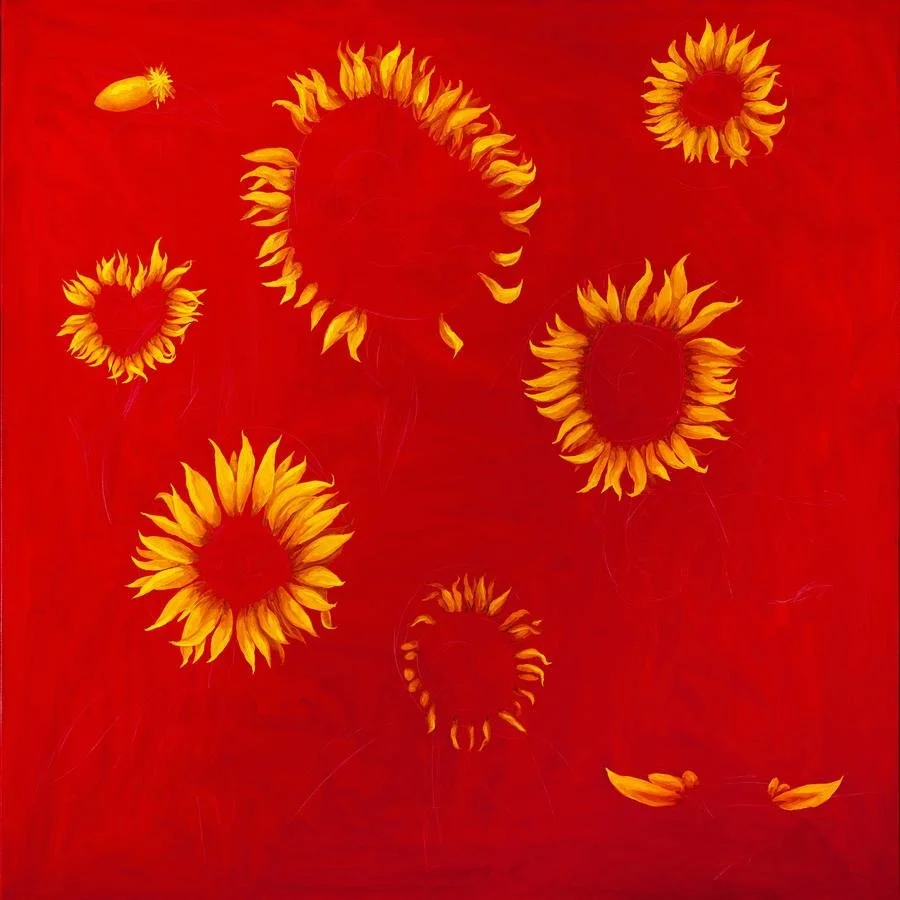
Perry Picasshoe, Picasshoe‘s Sunflowers, 2024, Oil on canvas, 36” x 36”
TORRANCE
NOT RED at TRYST
Aug 7 - 9, 2026
Del Amo Crossing
21535 Hawthorne Blvd, Torrance
For works in NOT RED, color is neither subject nor theme. Here red is a means without an end— be it therapeutic, iconoclastic, humorous, political, experimental, or allegorical.
Perry Picasshoe’s oil paintings, Sunflowers and The Guardian and the Spirit use red to generate a space of restorative safety, protection, and belonging. For Picasshoe, red also resonates with pre-Columbian dye traditions originating in present-day Mexico. At the same time, the artist leverages red’s optical tendency to approach the human eye to lend these paintings an assertive authority.
José Guadalupe Sánchez III’s work, Camacho, addresses the erasure and violence of imperialism by way of speculative fiction. Camacho forms part of a series envisioning a parallel world where cheap souvenir collectibles are afforded the veneration and respect given museum artifacts. In Camacho, the artist’s curio inhabits a red zone that references colonial exoticism and cultural appropriation by an increasingly aggressive Global North.
Anita Kucharczyk’s Continuance (series) is a pair of looping videos with sound that appropriate, refigure and recast existing sculptures through digital 3D simulation. The three figures in one video are derived from Auguste Rodin’s The Three Shades standing atop The Gates of Hell. In the artist’s Continuance of Rodin, the shades reflect the color of a turbulent and viscous red fluid. This roiling Styx emits a vortex of red particles, like condemned souls striving toward a red sun.
Ichiro Irie’s Little Red Courbet plays another riff on the canon with its pun on Prince’s classic 80’s anthem. From its notorious first exhibition to the present day, Courbet’s L’Origine du monde (The Source of the world) has stood on a razor’s edge of critical infamy. Courbet’s confrontational, unromantic address of— and collusion with— the male gaze, objectification, and cultural taboo remains an enduring site of crtitical debate. Here, Irie’s literalist pun sidesteps and mocks both Courbet’s gesture and the heated discourse surrounding it.
Jynx Prado’s column of gestural pastel studies are inspired by icons from various mythologies, principally Aztec. What the artist calls a "bloodshot red" ground in each drawing supports frenzied line work and garish color contrasts to convey a spectrum of vivid and intense emotions. Prado’s drawings render the elemental and often aggressive absurdity of the tales we pass on to each other, and ourselves, to make sense of a nonsensical world.
Carl Baratta’s painterly landscapes teeter playfully on the brink of both allegory and abstraction. Baratta’s four deceptively casual and contemplative plein air watercolors retain the artist’s practiced, almost medieval tension between flat picture plane and illusion of depth. They also evoke otherworldly realms more urgent than bucolic, more wild than composed, and more sinister than serene. The effect was the result of a simple field experiment: substituting blacks with reds.
About the Artists
Perry Picasshoe is a transgender Mexican American artist working at the intersections of participatory practice, Queer world-making, and Chicanx spatial politics. Their art is camp, whimsical and poignantly grounded in the charm of mundane. They create magical paintings, durational performances, and ephemeral installations that transform private sanctuary into collective ritual. Their work metabolizes the contradictions of embodied experiences, navigating traditional Latinx cultural frameworks, living with a bipolar disorder, and claiming space as a Queer person. They have a fundamental philosophy that art should be something you live in.
Carl Baratta is constantly investigating different ways of compressing multiple moments into a single scene, a common conceit of miniature painting & Sienese imagery. He also can't help cramming in references to Norse mythology, and other narrative sources that are visual, written, or sung. You know how Dr. Frankenstein is basically a kleptomaniac filching limbs and organs to build his monster? Carl does that but with stories and images that he loves and wants to see in the world.
Ichiro Irie Multidisciplinary artist Ichiro Irie’s current body of work playfully fuses, juxtaposes, celebrates, and dissects art historical works from the 20th century along with offerings from culture at large that have informed the artist's formation. Featured in his video, painting and sculptural works are a cast of characters with names such as Vincent Van Damme, Pikacho, and Frida J-Lo. For Tryst, 2025, Irie presents “International Klein Blues x Two” fusing two disparate cultural figures with conveniently matching surnames; one known for his overpriced, denim attire and the other for his ultra-ultramarine monochromes and associated performances involving naked ladies.
Jynx Prado critiques and questions social, cultural, and natural environments and the coexistence of them through an interdisciplinary practice. With mediums ranging from traditional drawing and painting, fiber, found objects and themself, they create humorous and yet uncanny characters and iconography to embody the irony and absurdity of sociopolitical events, community, and personal conflicts. Prado creates sculptures, performances and visuals that intertwines queerness, their Latino/a/x/e community and historical and mythological texts.
José Guadalupe Sánchez III is an interdisciplinary artist and educator born and raised in West Los Angeles. Relying heavily on self-reflexivity, their work is an investigation of the multilayered experiences of varying Brown social realities in Los Angeles spanning the past, present, and future. “Chamaco” is part of a series that explores the exoticization of ancient objects in Mesoamerica. Chamaco is a reflection on how Western cultures value and desire such items to decorate our homes, gift shops, museums, and textbooks, while at the same time vehemently devaluing the descendants of the peoples and cultures that produced them. Some questions that may arise are “What if these venerated objects reflected the indigenous people of today, the worlds they live, the objects they use? Would we care more? “How would we confront our wonder and amazement of ancient indigenous cultures as we watch their descendants work our fields, clean our buildings, watch over our kids, build our homes, make us our favorite foods, teach us, heal us, manage us, and be abducted in the streets?”
Anita Kucharczyk looks for light in color. Strongly influenced by the Light and Space Movement, she has a deep interest in how the luminous properties of color alter our perception of reality and how they affect our feelings. Each color and its visual properties carry a specific emotional resonance and—when used properly—can convey a spectrum of emotions to the viewer. Her work explores the properties and perception of light through various media, including painting, installation, animation, and projection mapping.
Estel Garrido-Spencer is an interdisciplinary artist whose current body of work investigates how the integration of natural material into a figurative practice might serve as a tool for reimagining human-nature relationships. Their work explores the concept of Embodied Ecology: a principle of fluidity between life forms that emphasizes viewing the human body as an extension of the natural world rather than an isolated entity within it. As a reflection of this fluidity, their process engages with the organic material substance of each artwork as their own creative agents. By positioning organic material as an active collaborator rather than a passive substance, their work proposes an alternative model of figurative practice grounded in ecological interdependence.
TRYST is a new international art fair for artist-run-spaces and collectives as well as an internationalSunday Panel discussions: 1-2 pm Networking for the socially anxious artist 3-4 pm Initiating a successful gallery exchange conference addressing the needs and future of global exchange for artist-run spaces, collectives, and organizations. A Torrance Art Museum (TAM) project, TRYST addresses the need for opportunities that foster artistic exchange between grass-roots artist organizations worldwide. This art fair will introduce international artists to Los Angeles, a leading center for contemporary art. Connecting artists to the art-savvy Los Angeles audience, the LA arts scene, and to one another allows unlimited networking opportunities in which artists can engage with other participants and develop further international exchanges. Talks and performances will be included in the program, as well as social events for participants. This will be the second edition of TRYST.